

Why planning before shopping matters
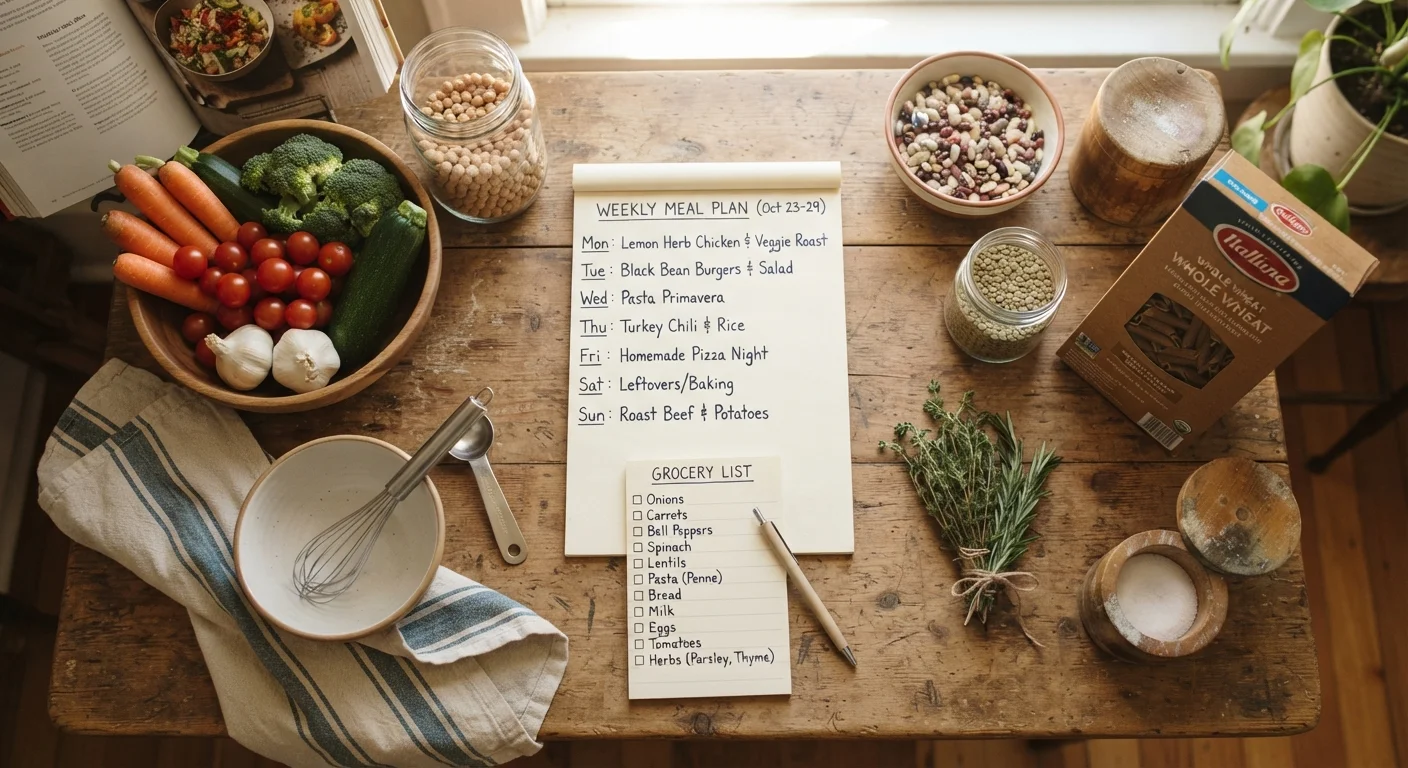
Most families overspend on groceries not because food is too expensive, but because they shop without a plan. Without knowing Tuesday's dinner when they buy Monday's groceries, they end up with duplicate items, forgotten staples, and produce that wilts before it gets used. A week planned on paper before checkout fixes all three problems at once.
If you are new to managing a household food budget, the foundation steps for family food budgeting are worth reading before you start. For now, the core idea is simple: your grocery list should be a byproduct of your meal plan, not the other way around.
Planning also lets you lean on overlapping ingredients. A bag of dried lentils bought for Monday's soup can reappear in Thursday's grain bowl. A whole cabbage bought for Wednesday's stir-fry feeds Friday's tacos too. That overlap is where the real savings happen. See which pantry staples anchor the most budget meals for a breakdown of which shelf-stable items pull the most weight.
How to build a week of dinners
What you will need
Check the store flyer before writing a single meal
Proteins are typically the most expensive line items in a dinner budget. Before you decide what to cook, look at what is on sale this week. If whole chickens are marked down, plan two or three chicken-based dinners. If canned tomatoes are discounted, a tomato-based pasta, soup, or shakshuka makes sense. Let the sales lead the plan rather than the plan lead the shopping.
Pick a budget anchor for each night
Assign each dinner a primary protein or main ingredient and a rough cost ceiling per serving. For a family of four on a tight budget, $1.50 to $2.50 per serving is a realistic range for most weeknights. Beans, eggs, lentils, and canned fish sit at the lower end. Bone-in chicken thighs, ground turkey, and pork shoulder sit at the mid range. Use at least two to three meatless nights per week to bring the weekly average down without sacrificing satiety.
Build overlapping ingredients across meals
Write all seven dinners on paper, then circle every ingredient that appears in more than one meal. Those overlapping items are your grocery anchors. A bag of dried black beans can go into Monday's tacos, Wednesday's rice and beans, and a Friday soup. Half a head of cabbage works in a slaw, a stir-fry, and a quick braise. The more overlap you build deliberately, the less produce you waste and the smaller your total grocery bill.
Write one consolidated shopping list
Add up the total quantity needed for each ingredient across all seven meals, then write a single list. Do not write a list per meal. Consolidating prevents buying a second onion on Thursday when you still have three at home, and it shows you the total outlay before you reach the register. Group the list by store section (produce, dry goods, dairy, meat) to move through the store faster and avoid backtracking.
Schedule cooking complexity to match your week
A slow-braised pork shoulder is fine for Saturday but unrealistic on a Tuesday when two kids have after-school activities. Look at your actual week and match each dinner to the time and energy available that night. Simple assembly meals (tacos, grain bowls, fried rice) belong on the busiest nights. Longer cooks belong on weekends or days when someone is home in the afternoon. A plan that ignores real schedules fails by Wednesday.
Account for leftovers explicitly
Look at your seven dinners and identify which two or three will produce enough food for a second meal. Write those leftover nights into the plan as actual dinner slots. A pot of lentil soup made on Monday feeds four to six adults; if your family is smaller, Tuesday is already planned. Label those nights on the plan so no one cooks something new when there is already food ready. Counting leftovers as meals is one of the fastest ways to cut the number of items you need to buy.
Review the plan and adjust for gaps
Before finalizing, read through all seven nights and check for nutritional variety, realistic cooking times, and ingredient shelf life. If three dinners all use fresh spinach but only one is in the first half of the week, move one spinach dinner earlier or swap spinach for frozen in the later recipes. Frozen vegetables cost less than fresh in most seasons and last indefinitely. The guide to eating well without overspending at the grocery store covers how to weigh fresh versus frozen for both nutrition and budget.
Handling leftovers and reducing waste
Leftovers should be accounted for in the plan itself. If Monday's pot of chili makes eight servings for a family of four, Tuesday's dinner is already done. Write that into the plan explicitly rather than hoping someone remembers what is in the fridge.
For ingredients that might not survive the week, cook them earlier rather than later. Spinach that goes into Monday's pasta will not last until Friday's frittata. Swap the order. The freezer guide for families explains which cooked dishes freeze well if you end up with more than the week can absorb.
Batch cooking one or two components, such as a big pot of rice or a sheet pan of roasted vegetables, is covered in more detail in the comparison of bulk cooking versus cooking fresh. Even modest batch work on Sunday afternoon can reduce weeknight cooking time by half.
When the weekly plan starts to feel routine, the beginner's guide to family meal prep adds structure around portioning and storage that makes the whole system more reliable.
The content provided on our blog site traverses numerous categories, offering readers valuable and practical information. Readers can use the editorial team’s research and data to gain more insights into their topics of interest. However, they are requested not to treat the articles as conclusive. The website team cannot be held responsible for differences in data or inaccuracies found across other platforms. Please also note that the site might also miss out on various schemes and offers available that the readers may find more beneficial than the ones we cover.