

Start here
Why most families don't have a food budget yet
Next
How to figure out what you're actually spending
Then
Setting a realistic weekly food number
Build on it
Building a simple system that sticks
Watch out for
Common early mistakes and how to avoid them
Why most families don't have a food budget yet
Food spending is the household bill that rarely gets the same attention as rent, a car payment, or a utility. It feels too variable to plan, too small to matter in any single transaction, and too tangled in emotions around feeding your family well. Those are real barriers, not excuses.
The result is that many families overspend on food for years without ever knowing it. Each grocery run, each pizza order, each drive-through stop seems reasonable on its own. The month-end total is a different story.
A food budget does not mean eating worse. It means spending less on things that do not actually matter to your family so you have more for things that do. The first step is simply deciding to look at the numbers. Everything after that is adjustable.
Food budget baseline
Your average weekly or monthly food spending before any changes. Establishing this number is the required first step before setting any savings target.
Cost per serving
The price of an ingredient or meal divided by the number of portions it produces. This calculation helps compare the real value of different food choices.
Meal planning
Deciding in advance what your household will eat for the week. Planning meals before shopping reduces impulse purchases and the chance of buying food that goes unused.
Food waste
Food that is bought but not eaten and has to be thrown away. Reducing waste is one of the most direct ways to lower a household food bill without changing what you buy.
Pantry staples
Shelf-stable ingredients kept on hand regularly, such as canned beans, rice, oats, and pasta. Staples form the low-cost foundation of many budget-friendly meals.
How to figure out what you're actually spending
Before you set any limits, you need a baseline. Pull two to four weeks of bank and credit card statements and mark every food transaction: groceries, takeout, coffee shops, meal kit deliveries, convenience store snacks, everything. Cash purchases are harder to track, so make a habit of saving paper receipts for this period.
Add up the total. Then divide by the number of weeks to get a weekly average. Most families are surprised by this number. That surprise is the point.
Separate the total into two buckets: food bought to prepare at home, and food bought ready to eat. This split usually shows where the biggest opportunities are. Takeout and restaurant spending is often two to three times higher than families estimate.
This tracking phase is not about judgment. It is about getting accurate data so the budget you build later has any chance of working. Two weeks of real numbers beats any guideline or rule of thumb.
Setting a realistic weekly food number
Once you have your baseline, you can set a target. The goal is a number that is lower than your current spend but not so low that your family revolts by week two.
A reasonable starting point is to reduce your tracked average by 10 to 15 percent. If your family has been spending $250 a week on all food costs, aim for $215 to $225 as your first target. You can tighten further once that number feels normal.
Meal planning is the most direct tool for hitting that target. When you know what you will cook each day, you buy only what you need, and you stop paying for ingredients that never get used. See our week of family dinners on a budget for a practical starting framework.
Cost-per-serving math helps prioritize ingredients. A pound of dry lentils or a bag of dried beans stretched across several meals costs far less per serving than even a modest cut of meat. Eggs, canned fish, and whole grains follow a similar pattern. These are not deprivation foods; they are the staples that allow for spending on other things your family values.
If your family's nutrition is part of your thinking here, our complementary guide on eating well as a family without overspending at the grocery store covers how to keep meals nutritious while managing costs.
Building a simple system that sticks
A budget no one monitors does not work. The system you use should take less than ten minutes a week to maintain. That is enough to stay on track without turning food management into a second job.
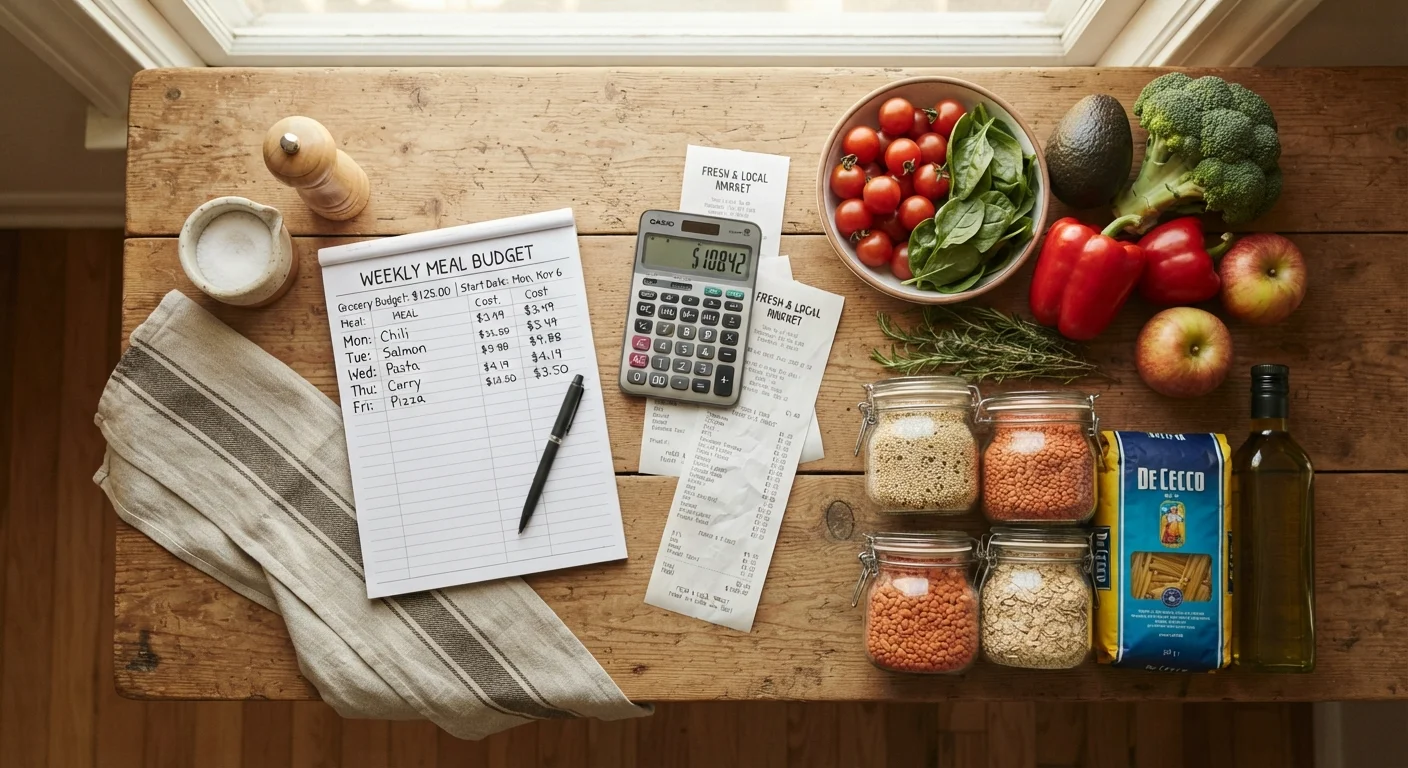
One approach: write next week's meals on Sunday, build a shopping list from those meals, and check your running total against your weekly target after each grocery trip. A notes app, a whiteboard on the fridge, or a simple spreadsheet all work equally well. The tool matters less than the habit.
Batch cooking reduces both cost and time. Cooking a large pot of grains, a tray of roasted vegetables, or a batch of a protein on the weekend gives you components for multiple meals during the week. Our guide to getting started with family meal prep covers how to begin without overcomplicating it.
The freezer is an underused budget tool. Buying proteins in bulk when prices are lower and freezing portions, or cooking double batches and freezing half, spreads costs across weeks. Our article on using frozen food smartly and safely explains how to build a practical frozen food rotation.
Common early mistakes and how to avoid them
The most common mistake is setting a target that is too aggressive too fast. A family that currently spends $300 a week on food cannot realistically cut to $150 in week one. The budget fails, everyone feels deprived, and the whole effort gets abandoned. Gradual reductions hold.
The second mistake is tracking groceries but ignoring everything else. A $12 lunch here and a $6 coffee run there add up faster than a full grocery haul. Food budgets only work when they cover all food spending.
Letting food waste go unexamined is the third common problem. Produce that rots, leftovers no one eats, and half-used pantry items bought for one recipe all represent money already spent on nothing. Reducing waste is often faster and easier than cutting any category of purchase. Our article on where family food budgets break down covers the most common spending leaks in detail.
Finally, treat the first budget as a draft. Your real spending patterns and your family's actual preferences will show you where the plan needs adjusting. After a month of tracking and one month of budgeting, you will have enough information to build something that works over the long term.
Review your budget after four weeks
After your first full month of budgeting, sit down with your receipts and statements and compare your target against what you actually spent. Note which weeks were hardest and why. One honest review after four weeks will tell you more about how to adjust than any general guideline can.
Frequently Asked Questions
There is no single right number. The USDA publishes food cost reports at different spending levels that families can use as a reference point. Most families find their actual spend lands somewhere they did not expect until they tracked it carefully for a few weeks.
Yes, and this is where many families find their biggest gap. Groceries and dining out should be tracked together as one total food cost. Separating them often masks how much the full picture adds up to.
Save every receipt for two to four weeks and add them up at the end. Bank and credit card statements work well for digital purchases. A free spreadsheet or a basic notes app is enough to get started.
Start by finding waste: food thrown away, duplicate items, and impulse buys. Cutting waste first usually frees up enough room to keep the foods your family actually uses. Restrictive cuts tend to fail quickly.
Meal planning lets you buy only what you will use, which reduces both overspending and food waste. A planned shopping list built around the week's meals typically costs less than unplanned trips where items go unused.
Most families need four to six weeks to move from tracking to a budget that feels natural. The first two weeks are just observation. Adjustments in weeks three and four bring the number closer to something realistic and sustainable.
The content provided on our blog site traverses numerous categories, offering readers valuable and practical information. Readers can use the editorial team’s research and data to gain more insights into their topics of interest. However, they are requested not to treat the articles as conclusive. The website team cannot be held responsible for differences in data or inaccuracies found across other platforms. Please also note that the site might also miss out on various schemes and offers available that the readers may find more beneficial than the ones we cover.