

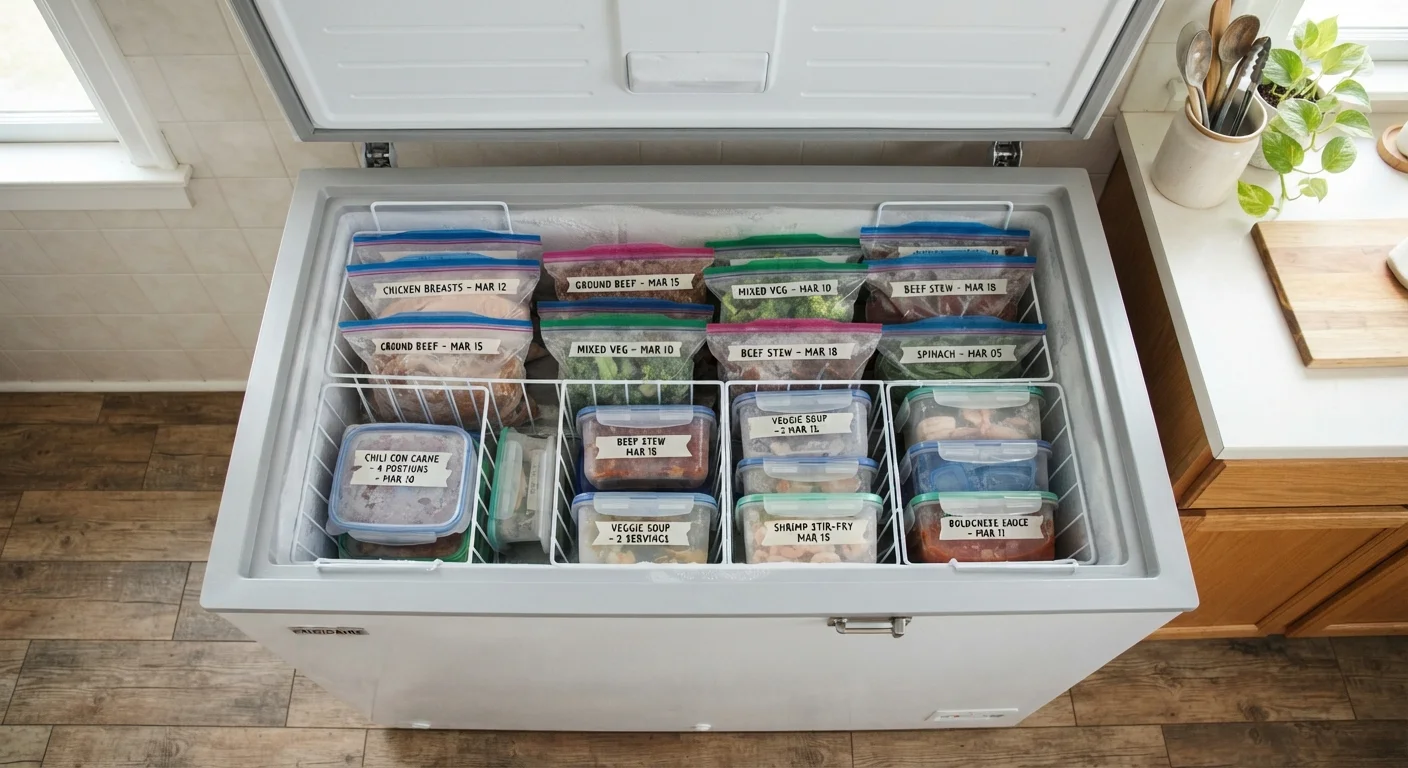
Why the freezer is a budget tool, not just a storage bin
Most families use the freezer reactively: leftovers go in, forgotten vegetables pile up, and eventually something gets thrown out with a layer of ice crystals. Treated as an active part of your food system, the freezer becomes one of the most reliable ways to stretch a grocery budget. Buying in bulk when prices drop, preserving produce before it spoils, and cooking large batches for future meals all depend on freezer capacity used wisely.
The freezer works alongside a weekly dinner plan because you can pull from frozen stock instead of buying fresh every night. That flexibility is what keeps per-meal costs low. Pairing freezer use with a broader household food budget makes both systems more effective.
Freezer basics: temperature, containers, and labeling
A home freezer should hold a steady 0 degrees Fahrenheit. At that temperature, bacterial growth stops and food stays safe indefinitely, though quality does decline after the recommended storage windows. Use an inexpensive appliance thermometer to check: many older freezers run warmer than their dial suggests, especially if the door seal has worn.
Container choice affects quality as much as temperature. Rigid plastic containers with tight lids, heavy-duty freezer bags with air pressed out, and vacuum-sealed bags all work well. Regular zip-lock sandwich bags are thinner and allow more air contact, which speeds up freezer burn. Freezer burn is the dry, grayish-white patches that form when food surfaces lose moisture to air: unpleasant in flavor but not a safety risk.
Labeling is where most families fall short. A marker on every container with the item name and the date it went into the freezer takes about five seconds and saves real money by preventing the guessing game that leads to food being thrown away.
A labeling habit that actually sticks
Keep a permanent marker and a roll of freezer tape or masking tape on top of the freezer. Write the item name and date before the container goes in, not after. Labeling at the point of freezing takes seconds; doing it later rarely happens.
What freezes well (and what does not)
Raw meats, poultry, and seafood freeze reliably. So do most vegetables after blanching (a brief boil followed by an ice bath that preserves color and texture). Fruit freezes well for smoothies, baking, and cooking, though it softens after thawing and is not ideal for eating fresh. Cooked grains like rice and farro, soups, stews, chili, and most casseroles all hold up well. Bread and baked goods freeze better than most people expect, provided they are wrapped tightly.
Foods that do not freeze well include anything with a high water content (cucumber, lettuce, raw tomatoes), cooked pasta and potatoes (they turn mushy), raw eggs in shells, mayonnaise-based salads, custards, and most soft cheeses. Cream sauces can separate after freezing, though incorporating them into a full dish rather than freezing alone helps.
Knowing this list before you shop helps you decide when buying in bulk makes sense and when it does not. See eating well without overspending for how freezer-friendly items fit into a nutritious family diet on a budget.
Building a first-in, first-out rotation
The principle is straightforward: older items get used before newer ones. In practice, this means placing new packages at the back of the freezer and pulling from the front. Organizing by food type (proteins on one shelf, vegetables on another, prepared meals in a separate bin) makes this easier to maintain.
A simple inventory list posted on or near the freezer door removes the need to dig around. It does not have to be detailed: a whiteboard or a sheet in a plastic sleeve with item names and dates is enough. Update it when items go in or come out. Families who do this consistently report using more of what they buy, which directly reduces waste and grocery spending.
$1,500+
Average annual food waste per U.S. household
According to USDA Economic Research Service estimates, the average American household discards a significant share of purchased food, with total retail and consumer food waste valued in the hundreds of billions of dollars annually.
0 degrees F
Safe freezer temperature for indefinite storage
The USDA recommends maintaining home freezers at exactly 0 degrees Fahrenheit to stop bacterial growth and keep food safe for the long term.
40 to 140 degrees F
The temperature 'danger zone' for bacterial growth
The USDA defines this range as the zone where bacteria multiply most rapidly, which is why counter thawing is unsafe for frozen food.
This rotation approach also supports batch cooking and meal prep, since you can stock the freezer intentionally with future meals rather than just storing leftovers.
Safe thawing: the rules that actually matter
Thawing on the kitchen counter is the most common food safety mistake in home kitchens. The outer surface of food reaches the temperature range where bacteria multiply (40 to 140 degrees Fahrenheit) long before the center thaws. The USDA identifies three safe methods: refrigerator thawing, cold water thawing, and microwave thawing.
Refrigerator thawing is the most hands-off. A pound of ground meat typically thaws overnight; a large roast may need 24 hours or more. Cold water thawing is faster: keep the food in a sealed bag, submerge it in cold water, and change the water every 30 minutes. Microwave thawing works when you plan to cook the food immediately, since some areas begin to cook during the process.
Food thawed in the refrigerator can be refrozen if you change plans, though some quality loss occurs. Food thawed by the other two methods should be cooked before refreezing.
Frequently Asked Questions
The USDA recommends using ground meat within 3 to 4 months and whole cuts of beef, pork, or lamb within 4 to 12 months for best quality. Food frozen at 0 degrees Fahrenheit remains safe indefinitely, but texture and flavor decline over time. Label packages with the freeze date so you use older items first.
Food thawed in the refrigerator can generally be refrozen, though some quality loss is expected. Food thawed in cold water or the microwave should be cooked before refreezing. Never refreeze food that was left to thaw at room temperature.
Raw eggs in shells, mayonnaise-based salads, cooked pasta or potatoes (they become mushy), watery vegetables like lettuce and cucumber, and most soft cheeses do not freeze well. Their texture changes significantly after thawing, making them unpleasant to eat.
Remove as much air as possible before sealing. Use freezer-safe zip-lock bags, wrap items tightly in plastic wrap before bagging, or use rigid airtight containers. Freezer burn happens when food surfaces dry out from air exposure; it is not a safety issue but does affect taste.
The three safe methods are: in the refrigerator (slow but hands-off), submerged in cold water with the bag changed every 30 minutes, or in the microwave if you plan to cook immediately. Thawing on the counter at room temperature allows the outer layers to reach unsafe temperatures while the center remains frozen.
A freezer runs most efficiently when it is about 75 to 80 percent full. A completely empty freezer wastes energy because cold air escapes every time you open the door. An overpacked freezer restricts air circulation and may leave some areas too warm.
The content provided on our blog site traverses numerous categories, offering readers valuable and practical information. Readers can use the editorial team’s research and data to gain more insights into their topics of interest. However, they are requested not to treat the articles as conclusive. The website team cannot be held responsible for differences in data or inaccuracies found across other platforms. Please also note that the site might also miss out on various schemes and offers available that the readers may find more beneficial than the ones we cover.