

Why daily movement matters and what it actually costs
The U.S. Department of Health and Human Services recommends that children ages 6 to 17 get at least 60 minutes of physical activity every day. For many families, the instinct is to enroll kids in organized sports or gym programs, which can run hundreds of dollars per season. However, research consistently shows that unstructured play and everyday movement deliver many of the same physical and developmental benefits as formal athletics.
This article covers practical, low-cost approaches that fit real family schedules and budgets. None of the ideas below require paid memberships or specialized gear to get started. For a broader look at keeping the whole household active without overspending, see our family fitness on a budget guide.
This article is for general informational purposes only and is not a substitute for advice from a qualified healthcare or fitness professional. Consult your child's pediatrician before making significant changes to their activity level, especially if your child has a health condition.
Use public parks and trails as your main venue
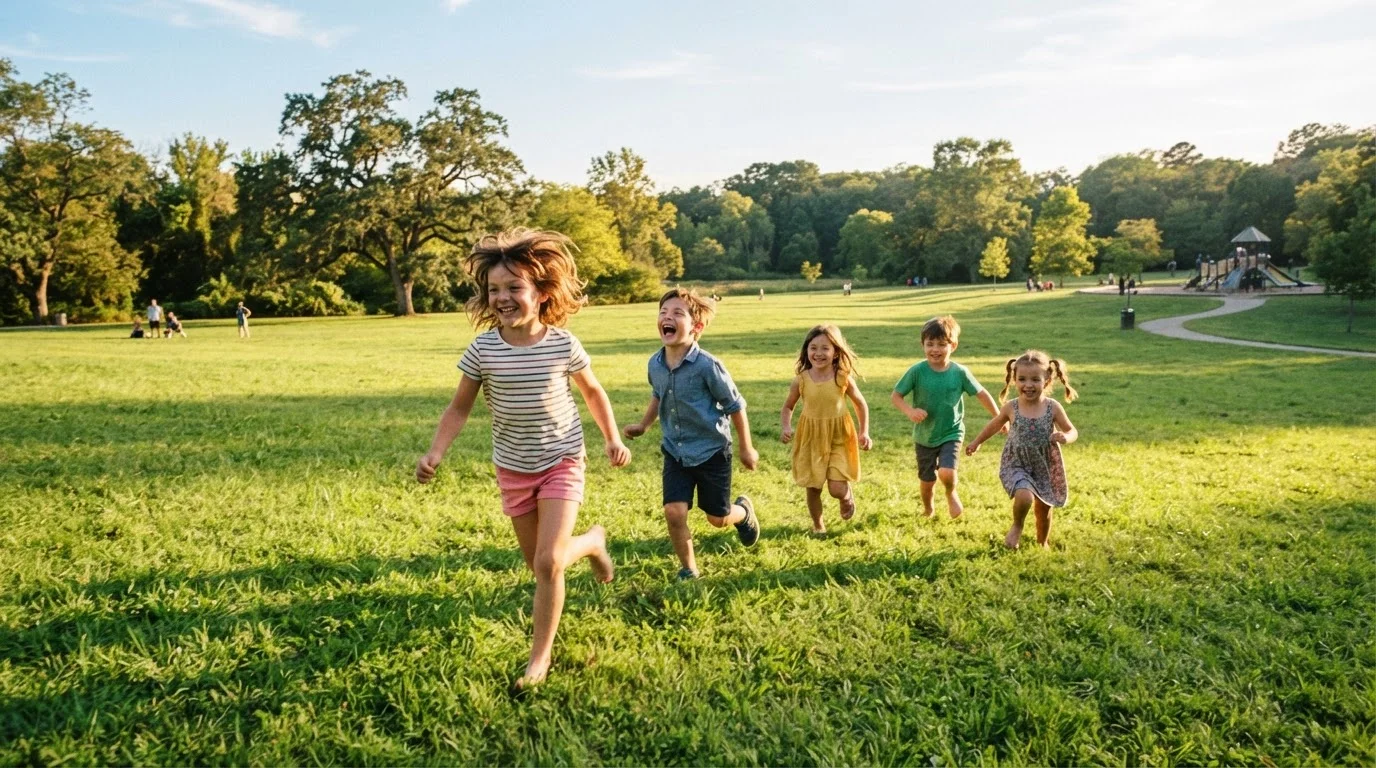
Public parks are the most accessible free fitness resource most families already have nearby. Open fields invite running, jumping, and informal games. Paved paths work for biking, scootering, and walking. Many parks also have playground equipment that builds upper body strength, balance, and coordination without any cost to the family.
Check your city or county parks department website for seasonal programming. Many offer free or low-cost drop-in sports clinics, nature walks, and family fitness events, particularly in summer and fall.
Public parks offer running, climbing, and seasonal programs that cost nothing to access.
Turn everyday errands into movement opportunities
Walking or biking to nearby destinations, school, the library, or a friend's house, adds meaningful activity without any planning or equipment beyond a helmet. Even parking farther from a store entrance and walking the extra distance adds up over a week.
Children who walk or bike regularly as part of daily routines tend to accumulate physical activity more naturally than those who rely solely on scheduled sessions. Safety considerations matter here: use sidewalks, crosswalks, and proper bike lanes, and make sure children are supervised appropriately for their age and the route.
Walking or biking for daily errands adds real activity without scheduling or gear costs.
Revive classic outdoor and backyard games
Games like tag, hide-and-seek, four square, and jump rope require minimal or no equipment and can involve multiple children at once. A simple piece of sidewalk chalk can create hopscotch grids or obstacle courses that keep younger children engaged for extended periods.
A jump rope costs a few dollars and can support a wide range of solo and group activities. Similarly, a standard playground ball opens up four square, kickball, and other group games that work in driveways, cul-de-sacs, or small yards. These activities develop agility and cardiovascular fitness in ways that children often do not recognize as exercise.
A jump rope or playground ball can fuel hours of active play for just a few dollars.
Look into community recreation centers and YMCAs
Many municipal recreation centers offer sliding-scale memberships or free youth activity passes for qualifying families. Programs vary widely, but common offerings include open gym time, swimming lessons, youth fitness classes, and after-school sports programs. Rates at public recreation centers are often a fraction of private gym pricing.
YMCAs in many communities have financial assistance programs that can significantly reduce or eliminate membership costs for families who qualify. Contact your local branch directly and ask about their financial assistance or scholarship programs. Availability varies by location, so it is worth the inquiry.
YMCA financial assistance programs can eliminate membership costs for qualifying families.
Use free online and library-based movement resources
Public libraries are an underused source of physical activity content. Many circulate exercise equipment, such as hand weights or yoga mats, through their lending programs. Libraries also frequently stock fitness DVDs and books with structured movement programs for children of different ages.
Free YouTube channels specifically designed for children include structured dance, yoga, and movement sessions that run 10 to 30 minutes and need no equipment. These work well on rainy days or during winter months when outdoor time is limited. Our guide to free community health resources covers more about what libraries and nonprofits typically provide.
Many public libraries lend fitness equipment and stock children's movement programs at no cost.
Explore school and nonprofit sports programs
Many school districts run intramural sports, physical education extensions, or after-school activity clubs that are either free or heavily subsidized. Local nonprofits and faith-based organizations also often run youth sports leagues with fees well below those of private clubs, and some offer need-based scholarships.
Programs through organizations like Boys and Girls Clubs or community sports leagues typically prioritize participation over competition, making them accessible to children at different skill levels. Fees, availability, and age ranges vary, so contact programs in your area to get current details.
School intramural programs and nonprofit leagues often cost far less than private club sports.
Making it stick without spending more
The strategies above work best when movement becomes part of the day's rhythm rather than a separate scheduled event. Walking to school, playing in the yard after dinner, or spending Saturday mornings at the park all count toward the daily goal. Consistency matters more than intensity at this age.
Short bursts of activity add up
Children do not need to complete 60 minutes of activity all at once. Three 20-minute sessions spread across the day count just as much toward the daily recommendation as one continuous block. Breaking movement into shorter periods can be easier to fit around school schedules, homework, and mealtimes.
Families looking for local no-cost options can find more detail in our guide to free community health resources. If you want to extend activity indoors, our affordable home workout space guide covers simple setups that work well for children too.
The content provided on our blog site traverses numerous categories, offering readers valuable and practical information. Readers can use the editorial team’s research and data to gain more insights into their topics of interest. However, they are requested not to treat the articles as conclusive. The website team cannot be held responsible for differences in data or inaccuracies found across other platforms. Please also note that the site might also miss out on various schemes and offers available that the readers may find more beneficial than the ones we cover.