

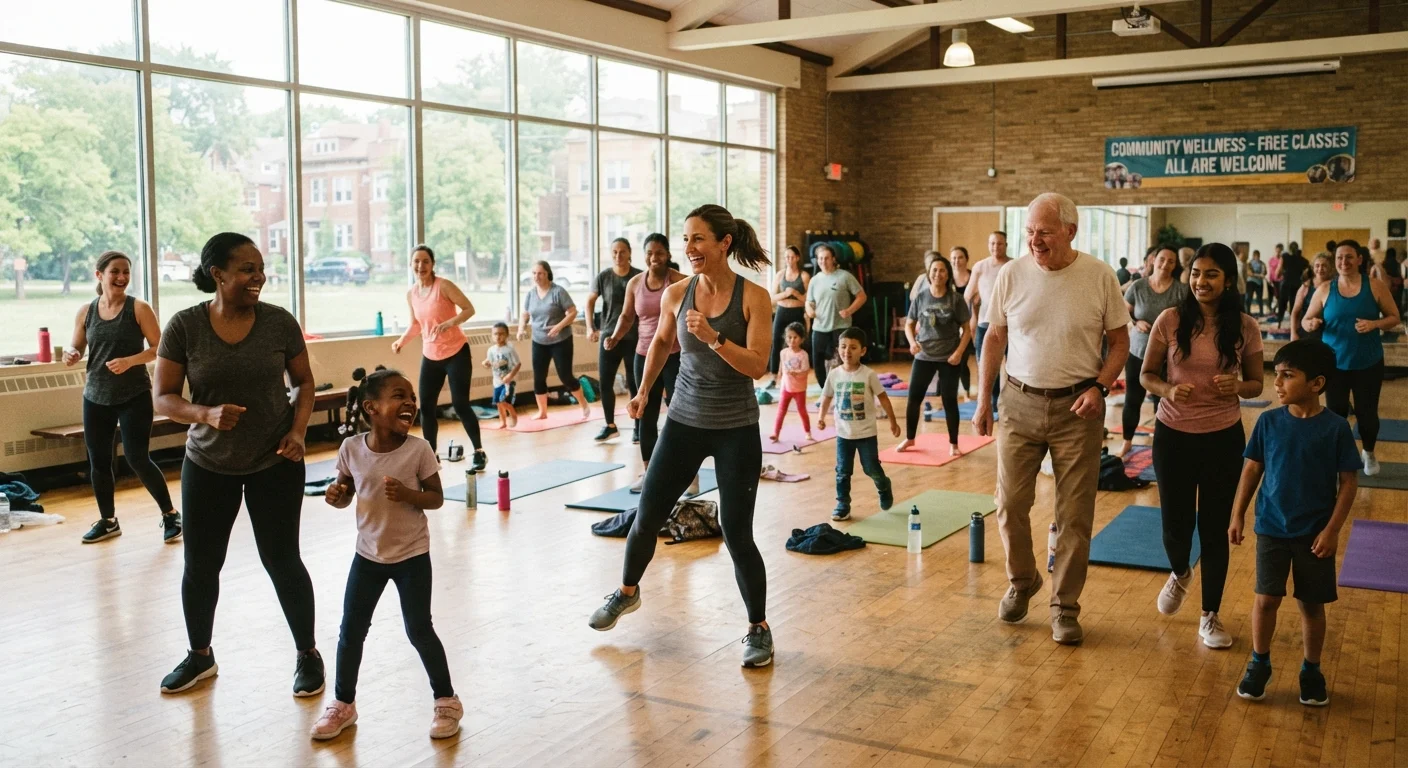
What counts as a free community health resource
The term covers a wide range of services available to the public at no direct cost or on a sliding fee based on income. Public parks, libraries, health departments, federally qualified health centers (FQHCs), nonprofit clinics, food pantries, and faith-based organizations all fall under this umbrella.
The common thread is that these resources are funded through taxes, grants, or charitable donations, so the cost to the individual user is zero or very low. Many families never use them simply because they do not know they exist or assume they must be uninsured to qualify. In reality, most programs are open to any resident regardless of insurance status or income.
For families looking to stretch their health and fitness budget, these resources can replace or supplement paid gym memberships, dietitian consultations, and preventive care visits. See practical strategies for family fitness on a tight budget for a broader picture of low-cost approaches.
Libraries and parks as health hubs
Public libraries have expanded well beyond books. Many branch locations now host free yoga classes, walking groups, mental health workshops, and health literacy programs. Some libraries partner with local hospitals to run free screenings for blood pressure, diabetes risk, and vision. These events are typically listed on the library's events calendar and require no library card to attend.
Public parks departments run free and low-cost structured programs as well. Many cities offer free outdoor fitness classes in warm months, free swimming lessons for children at public pools, and supervised youth sports leagues with no or minimal registration fees. Trails, tennis courts, basketball courts, and open fields cost nothing to use.
Check your library's events calendar first
Most public library systems update their events pages monthly and list free health and fitness programs alongside other community events. Searching the calendar by category or keyword such as 'wellness' or 'fitness' takes less than two minutes and often surfaces programs that are not advertised anywhere else.
For ideas on getting children physically active through community programs specifically, free and low-cost ways to get kids moving every day covers practical options by age group.
Health departments and federally qualified health centers
County and city health departments are a direct source of free preventive services. These commonly include immunizations, family planning services, tuberculosis testing, and sexually transmitted infection screenings. Many health departments also run free or very low-cost dental screenings and mental health first aid training for caregivers.
FQHCs are a separate but related resource. These federally funded clinics are required by law to provide primary care, dental care, behavioral health services, and pharmacy access to anyone who walks in, with fees scaled to income. A family of four with a modest income may pay only a few dollars per visit. You can locate the nearest FQHC through the Health Resources and Services Administration (HRSA) website by entering your zip code.
1,400+
Federally qualified health center sites in the US
According to the Health Resources and Services Administration (HRSA), FQHCs operate more than 14,000 service delivery sites nationwide, serving patients regardless of ability to pay.
211
Free helpline connecting residents to local health services
The 211 helpline, available in most US states, routes callers to local social, health, and crisis services at no charge, according to United Way Worldwide.
6.5 million
Children served by WIC annually
The USDA reports that the WIC program serves approximately 6.5 million participants per month, including children under age five, across all 50 states.
Nonprofits, food programs, and nutrition support
Nutrition is a central part of family health, and several free programs address it directly. The USDA's WIC program provides free food packages and nutrition counseling to eligible pregnant women, new mothers, infants, and children under five. The Supplemental Nutrition Assistance Program (SNAP) helps low-income households afford groceries. Both programs have eligibility requirements and are worth checking even if you are unsure whether you qualify.
Community food pantries and food banks, many of which operate through nonprofits or faith communities, distribute groceries at no cost. Some also offer free cooking classes, recipe guides, and connections to dietitian volunteers. These are particularly useful for families trying to eat well on a limited food budget. You can find local food resources through the food and drink section of this site or by calling 211.
Nonprofit health clinics and community wellness organizations sometimes offer free fitness programming, chronic disease education classes, and peer support groups. Local chapters of national organizations focused on heart health, diabetes, or cancer prevention frequently run free community workshops open to anyone.
This article is for general informational purposes only and is not a substitute for professional medical advice. Always consult a qualified healthcare provider for guidance specific to your health situation.
Frequently Asked Questions
Start by calling your county or city health department, which maintains lists of local programs. The 211 helpline (dial 2-1-1 from any phone) connects callers to local social and health services at no cost. Public library websites and community bulletin boards are also reliable starting points.
Many free screenings, such as blood pressure checks and cholesterol tests, are conducted by licensed health professionals and produce accurate results. They are a reasonable starting point for identifying potential concerns. However, a positive or borderline result should always be followed up with a qualified healthcare provider for a complete evaluation.
Most library and park-based fitness classes require no membership. Some programs ask for a free registration to manage attendance, which you can typically complete online or by phone. Sliding-scale programs at recreation centers may ask for proof of income.
Yes. Many programs are designed specifically for children, including after-school fitness activities, youth sports leagues, and child nutrition programs such as summer meal sites. Some family-focused programs serve parents and children together.
A federally qualified health center (FQHC) is a government-funded clinic that must serve all patients regardless of their ability to pay. Fees are set on a sliding scale based on household income, so many patients pay little or nothing. You can find the nearest FQHC through the Health Resources and Services Administration (HRSA) website.
The content provided on our blog site traverses numerous categories, offering readers valuable and practical information. Readers can use the editorial team’s research and data to gain more insights into their topics of interest. However, they are requested not to treat the articles as conclusive. The website team cannot be held responsible for differences in data or inaccuracies found across other platforms. Please also note that the site might also miss out on various schemes and offers available that the readers may find more beneficial than the ones we cover.