

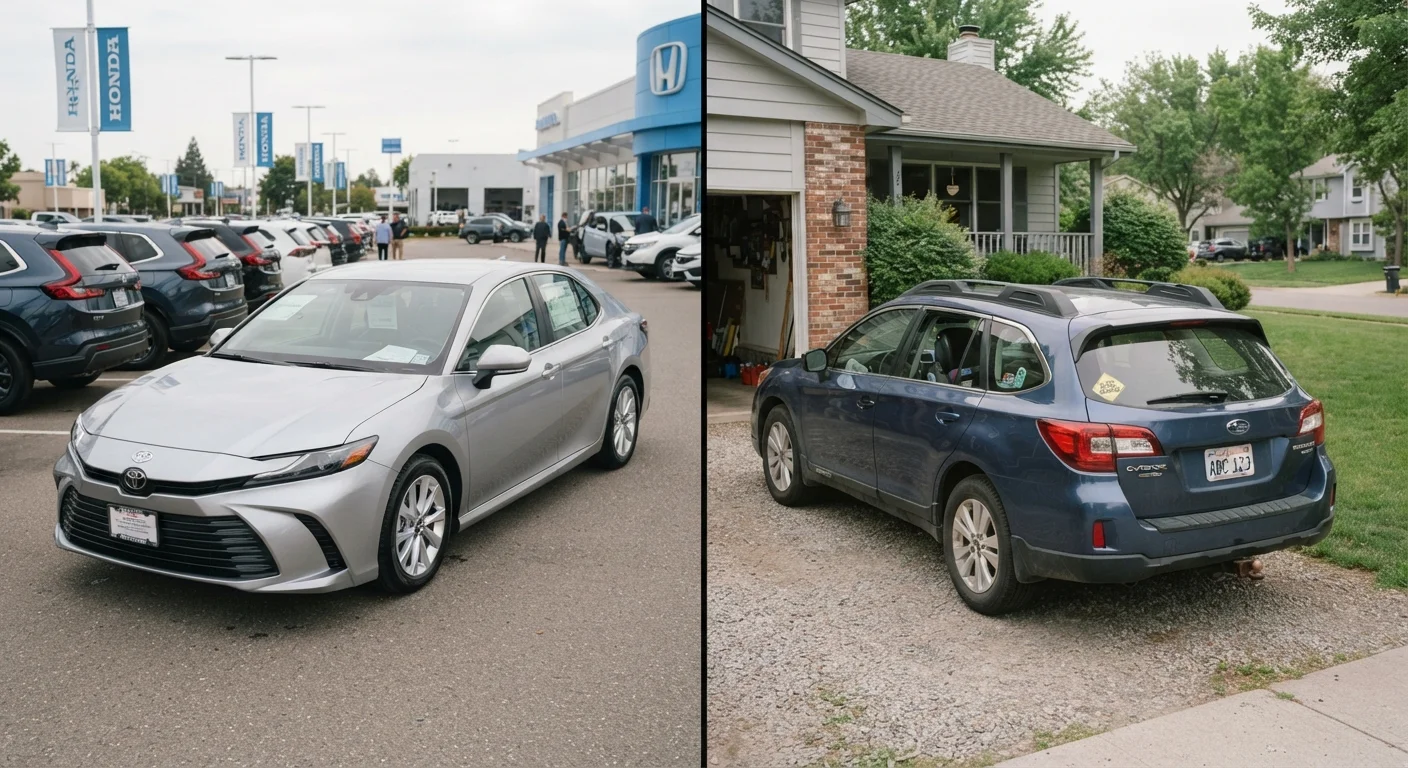
Option A
New car
The full-warranty, zero-history option.
Best for: Families who prioritize predictable costs, current safety technology, and manufacturer support over the lowest purchase price.
Option B
Used car
The lower-sticker, faster-depreciation-absorbed alternative.
Best for: Families who want to minimize upfront spending and monthly payments, and are comfortable with some ownership uncertainty.
How depreciation shapes the five-year picture
Depreciation is the single largest cost in car ownership, and it falls unevenly. A new vehicle typically loses around 20 percent of its value in the first year alone, with the cumulative drop reaching roughly 50 percent by year five. When a family buys used, a previous owner has absorbed that early, steep loss.
A car that sold new for $35,000 may be available used at $21,000 after three years. The family buying it used still loses value over the next five years, but they start from a lower base. That difference in starting price flows through every other cost: the loan balance is smaller, insurance replacement value is lower, and registration fees (which many states tie to vehicle value) are reduced.
For families comparing options, the relevant number is not sticker price alone. It is total depreciation over the ownership window. Leasing sidesteps depreciation ownership entirely, but introduces its own trade-offs worth reviewing separately.
| Criterion | New car | Used car |
|---|---|---|
| Purchase price (typical family vehicle) | Higher sticker price | Lower sticker price |
| Depreciation over 5 years | Larger total dollar loss | Smaller total dollar loss |
| Loan interest rate | Generally lower | Generally higher |
| Warranty coverage | Full factory warranty | Varies; CPO adds coverage |
| Insurance premiums | Higher (based on value) | Lower (based on value) |
| Registration and taxes | Higher in most states | Lower in most states |
| Repair risk in year 1-3 | Low (warranty covers most) | Moderate to high |
| Safety technology | Latest driver-assist features | Depends on model year |
Financing, insurance, and registration costs
New car loans have historically carried lower interest rates than used car loans because lenders view new vehicles as lower risk. The gap can be two to four percentage points, depending on credit profile and market conditions. On a five-year loan, that rate difference partially offsets the higher principal on a new car.
Insurance costs follow the vehicle's value. Comprehensive and collision coverage for a $35,000 new car will generally be higher than for a $21,000 used car of the same model. Families who carry only liability on older paid-off vehicles can reduce premiums further, though that only makes sense once a car's value is low enough that full coverage is not financially justified.
State registration and personal property taxes, where applicable, are usually calculated on vehicle value. A newer, higher-value car produces larger annual bills on both counts.
~20%
New car value lost in year one
Industry data from sources including Edmunds and Carfax has consistently shown new vehicles lose roughly 20 percent of their value within the first 12 months of ownership.
~50%
Depreciation by year five on a new vehicle
By the end of a five-year ownership period, a new car typically retains only around half its original purchase price, according to broadly cited automotive valuation estimates.
2-4 pts
Typical interest rate gap: new vs. used loans
Used car loan rates have historically run two to four percentage points higher than new car rates, based on Federal Reserve consumer credit data and lender surveys.
Maintenance and repair: where used cars catch up
New cars carry manufacturer warranties, typically three years or 36,000 miles for bumper-to-bumper coverage and five years or 60,000 miles for powertrain. Those warranties make the first ownership years relatively low-cost for repairs. A used car purchased outside warranty coverage transfers all repair risk to the buyer immediately.
As a vehicle passes 60,000 to 100,000 miles, component wear accelerates. Tires, brakes, belts, and suspension parts all become line items. A family buying a three-year-old car with 36,000 miles may face those costs within the five-year window. Staying current on scheduled maintenance helps, but it does not eliminate the reality of aging parts. Consistent maintenance habits can reduce repair bills significantly regardless of which route a family chooses.
One practical middle ground: a certified pre-owned (CPO) vehicle from a manufacturer program extends warranty coverage on a used car, often to 100,000 miles on the powertrain. CPO vehicles carry a price premium over non-certified used cars, but that cost buys meaningful protection for families who want used-car pricing with reduced repair uncertainty.
For families considering a used purchase for the first time, a complete walkthrough of the used-car buying process covers vehicle history checks and pre-purchase inspections in detail.
Putting the numbers together
A rough five-year comparison for a family-sized vehicle (sedan or SUV in the $25,000 to $35,000 new price range) might look like this. The new car buyer faces higher depreciation, higher insurance, and higher registration costs, partially offset by a lower loan rate and warranty savings on repairs. The used car buyer faces lower depreciation loss, lower insurance, and lower registration, partially offset by a higher loan rate and out-of-pocket repair costs.
When researchers have modeled five-year ownership costs across vehicle segments, used cars in the two-to-four-year-old range have generally come out lower in total spend, though the margin narrows when CPO premiums, higher used-loan rates, or significant repair events are factored in. No single number applies to every family, because mileage driven per year, local insurance markets, and individual financing terms all shift the outcome.
Families stretched across multiple budget categories benefit from thinking about the car decision alongside other large expenses. Understanding where food budgets break down is one example of finding room that can support a more conservative vehicle payment. Timing a purchase strategically can also affect the effective price paid on either a new or used vehicle.
The content provided on our blog site traverses numerous categories, offering readers valuable and practical information. Readers can use the editorial team’s research and data to gain more insights into their topics of interest. However, they are requested not to treat the articles as conclusive. The website team cannot be held responsible for differences in data or inaccuracies found across other platforms. Please also note that the site might also miss out on various schemes and offers available that the readers may find more beneficial than the ones we cover.