

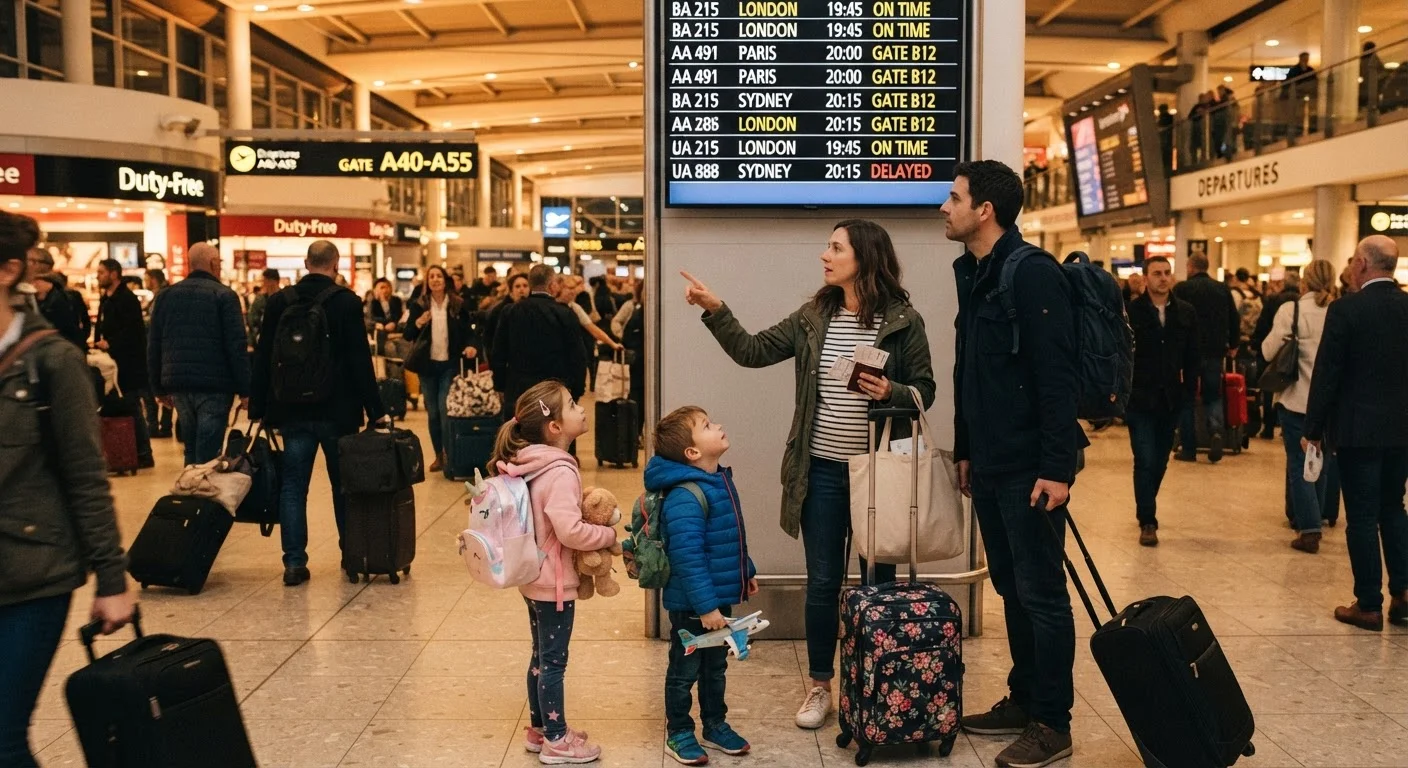
Why flying with kids catches families off guard
Flying is one of the faster ways to reach a destination, but the economics and logistics change considerably once children are in the picture. Seats cost more per person, bags multiply, and the margin for error on tight connections shrinks. Families who have driven everywhere and are flying together for the first time often discover that the advertised fare is only a starting point.
The good news is that most of the friction is predictable. The mistakes below come up repeatedly because the system is not designed with families as the default traveler. Understanding where the gaps are lets you plan around them rather than absorb the cost or stress on travel day.
If you are also thinking about when to fly, traveling off-season can reduce both fares and airport congestion, which makes the logistics here more manageable.
The most common mistakes families make when flying
Choosing a connecting flight because it costs less, without accounting for the connection time or airport layout.
Why it happens: The fare difference between a nonstop and a one-stop flight can be $100 or more per person, which looks compelling when multiplying across a family of four.
Assuming children's fares, free bags, or seat perks apply the same way across all airlines.
Why it happens: Policies differ significantly between carriers, and families often base assumptions on a past experience with a different airline.
Packing the carry-on for the destination rather than the flight itself.
Why it happens: Parents think ahead to the hotel and forget that several hours in a pressurized cabin with a bored six-year-old requires its own preparation.
Skipping travel insurance or not understanding what it covers before buying.
Why it happens: Families often add travel insurance at checkout without reading coverage terms, or skip it entirely to save money.
Not accounting for airport logistics in the overall travel day timeline.
Why it happens: Families estimate arrival time based on adult travel habits, without adjusting for slower security lines, bathroom stops, and a child who decides a moving walkway is the most interesting thing on Earth.
Booking flights at the lowest fare without checking what is and is not included.
Why it happens: Basic economy and similar stripped-down fare classes often appear first in search results, and the total price looks right until fees are added.
Loyalty programs are a related area worth understanding before you book. They do not always work the way families expect, and the mechanics of airline loyalty programs are worth reading before assuming points will offset your costs.
What to do once you have booked
Verify seat assignments before the day of travel
Many airlines will not automatically seat children next to their parents unless seats are paid for or manually assigned at booking. On a full flight, gate agents may have limited options to fix this. Log in to your booking after purchase and confirm your family's seats are together before the travel date.
After booking, three tasks are worth doing promptly. First, log in and confirm seat assignments. Second, note the airline's check-in window and set a reminder to check in as early as allowed, since earlier check-ins often get better seat options on partially full flights. Third, verify your bag allowance and measure your carry-ons against the airline's listed dimensions, since carriers differ and gate-checking a bag at the last minute adds friction.
Food planning matters too. Airport food is expensive, and children's hunger does not respect delays. Packing snacks that clear security is straightforward, and managing food costs during travel covers this in more detail. A full child is a calmer child, and a calmer child makes the whole flight easier for everyone nearby.
For a broader look at where family travel budgets quietly grow, common myths about affordable family travel covers several assumptions worth questioning before you finalize any trip.
The content provided on our blog site traverses numerous categories, offering readers valuable and practical information. Readers can use the editorial team’s research and data to gain more insights into their topics of interest. However, they are requested not to treat the articles as conclusive. The website team cannot be held responsible for differences in data or inaccuracies found across other platforms. Please also note that the site might also miss out on various schemes and offers available that the readers may find more beneficial than the ones we cover.