

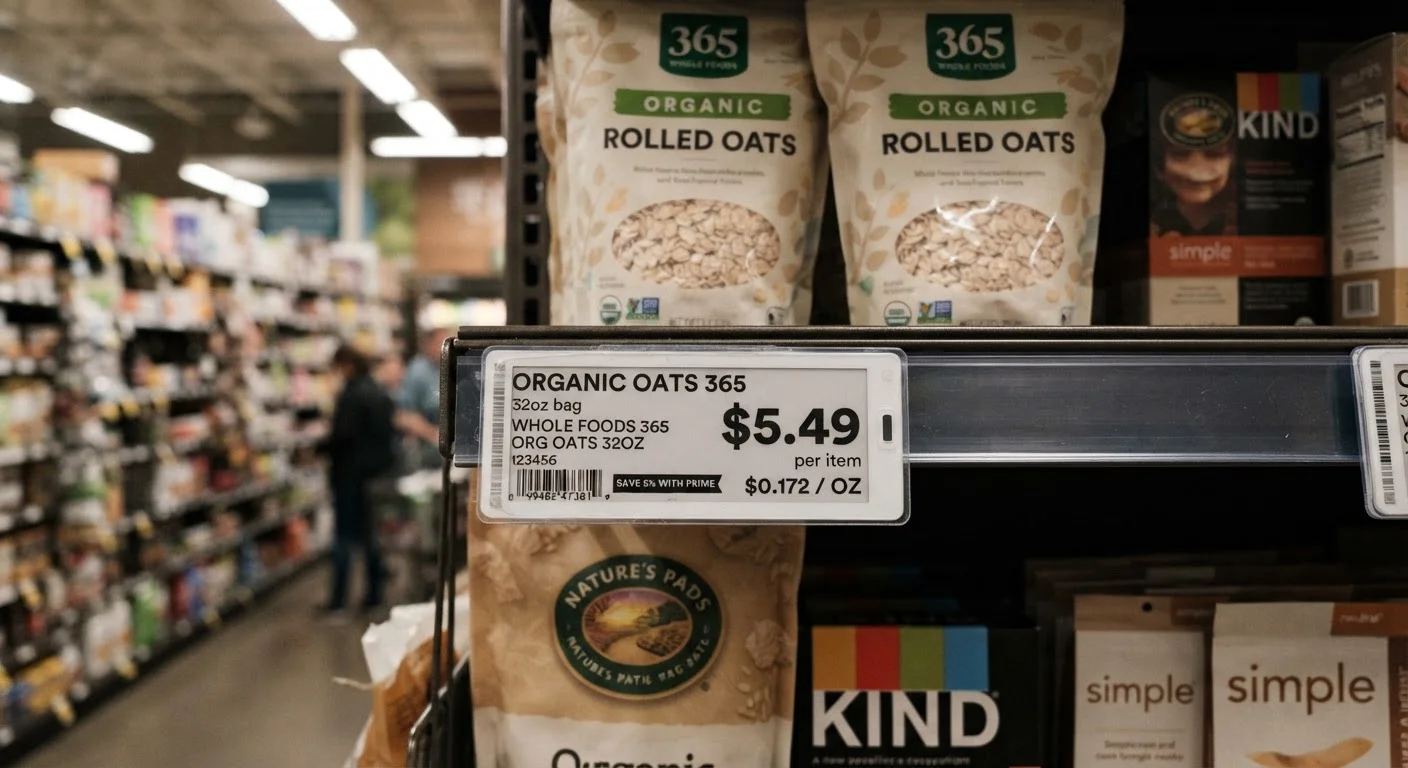
What the shelf label is actually telling you
Most grocery shelf labels show two prices: the total price in large print, and the unit price in small print. The total price tells you what you will pay at checkout. The unit price tells you what you are paying for each ounce, pound, count, or fluid ounce inside the package.
The unit is the critical part. Cereal is usually priced per ounce. Bottled water is priced per fluid ounce. Eggs are priced per egg. Paper towels are priced per sheet. Because the unit is standardized across every item in that category, you can place two completely different packages side by side and know instantly which one costs less for the same amount of product.
Most stores print the unit price in a smaller font, sometimes in a different color, near the top or bottom of the shelf tag. Some chains integrate it into a digital label. If a shelf is restocked or mislabeled, a unit price can be missing. In that case, the math is simple: divide the total price by the net weight or count on the package.
Unit pricing rules vary by state
Not every store in every state is required to display unit prices. Smaller stores and certain retail formats may be exempt under local law. If unit prices are absent from a shelf label, dividing the package price by the net weight or count printed on the package gives the same number. A basic calculator app on your phone handles this in seconds.
Why bigger is not always cheaper per unit
The assumption that the largest package always wins on unit price is common and often wrong. Retailers price each size independently. A 32-ounce bottle of dish soap might cost $0.09 per ounce while the 64-ounce bottle costs $0.11 per ounce. The larger package has a lower sticker price per bottle but a higher cost per ounce.
Sales complicate this further. A 12-pack of canned beans on promotion can beat the unit price of a warehouse-club case. A store brand in a medium size can undercut a name brand's largest size. This is why comparing store brands to name brands on a per-unit basis, rather than by sticker price alone, gives a clearer picture of actual value.
30+
U.S. states with unit pricing laws for grocers
The National Institute of Standards and Technology has tracked state-level unit pricing regulations, which vary in scope and enforcement across jurisdictions.
Up to 40%
Per-unit price difference between package sizes
Consumer research has documented cases where mid-size or sale-priced packages carry per-unit costs significantly lower than the largest available size in the same product category.
$500+
Potential annual household grocery savings
Consumer advocates have estimated that consistently choosing lower unit-price options on regularly purchased staples can produce several hundred dollars in annual savings for an average household.
Comparing across categories and product types
Unit pricing works across product types, but only when the unit matches. If one yogurt is labeled per ounce and another is labeled per pound, the numbers cannot be compared directly. Multiply the per-ounce price by 16 to convert it to per-pound, or divide the per-pound price by 16 to bring it down to per-ounce. Either approach works; pick the direction that feels easier.
Count-based unit prices, common for items like individually wrapped snack bars or single-serve packets, can obscure weight differences between items. A granola bar priced at $0.50 per bar is not comparable to one priced per ounce unless you know both bars weigh the same. When size varies within a category, weight-based unit prices are more reliable for cost comparison.
Applying this habit beyond food is straightforward. The same logic that helps you choose between two sizes of olive oil works for laundry detergent, shampoo, and cleaning supplies. For a broader look at how low sticker prices can mislead, understanding hidden costs in other categories follows a similar pattern of looking past the headline number.
Putting unit pricing to work on a family grocery budget
Unit pricing is most useful when it is part of a routine rather than an occasional check. Before adding an item to the cart, a quick glance at the unit price and a mental comparison to the alternative on the shelf takes about five seconds. Over a full shopping trip, those checks can redirect spending toward better-value options without changing what the family eats.
For pantry staples like pasta, canned tomatoes, dried beans, and rice, unit pricing matters most because these items are purchased repeatedly. Small per-unit differences multiply across dozens of purchases per year. A family that consistently buys the lower unit price option on five pantry staples can see meaningful savings over twelve months without switching brands or changing recipes.
Unit pricing also works alongside meal planning strategies for families on a budget. When you know the unit price of an ingredient, you can calculate the true cost of a meal per serving rather than guessing from package prices. That feeds directly into decisions about which meals are genuinely affordable and which ones only look inexpensive at first glance. For more on reading grocery labels accurately, a parent's guide to nutrition labels covers the other numbers worth checking before anything goes in the cart.
Make unit price checks a quick habit
You do not need to check every item every trip. Focus on the products you buy most often: staples, dairy, canned goods, and cleaning supplies. Once you know the usual unit price for your regular items, you will notice immediately when a different size or brand offers a genuine improvement. That pattern recognition builds quickly and costs almost no extra time at the shelf.
Frequently Asked Questions
It is usually printed in smaller type at the top or bottom of the shelf label, below the large total price. It shows a dollar amount followed by a slash and the unit, such as '$0.18 / oz'. If a label is missing, check the store's app or ask a store employee.
Not always. Retailers set prices independently, and a mid-size package or even a smaller package on sale can beat the per-unit cost of the bulk size. Always check the unit price rather than assuming size determines value.
You cannot compare them directly. Convert one to match the other before comparing. For example, if one label shows price per ounce and another shows price per pound, divide the per-pound price by 16 to get the per-ounce equivalent.
That depends on the store's system. Some stores update the shelf label unit price to reflect a current sale; others show only the regular unit price. Check whether a displayed sale price changes the unit cost before deciding.
Yes. Unit pricing works for paper towels, laundry detergent, shampoo, and most other household goods sold in varying sizes. The same logic applies: find the common unit and compare directly.
Use your phone's calculator. Divide the total price by the net weight or count printed on the package. That gives you the unit price you can use to compare options on the spot.
The content provided on our blog site traverses numerous categories, offering readers valuable and practical information. Readers can use the editorial team’s research and data to gain more insights into their topics of interest. However, they are requested not to treat the articles as conclusive. The website team cannot be held responsible for differences in data or inaccuracies found across other platforms. Please also note that the site might also miss out on various schemes and offers available that the readers may find more beneficial than the ones we cover.