

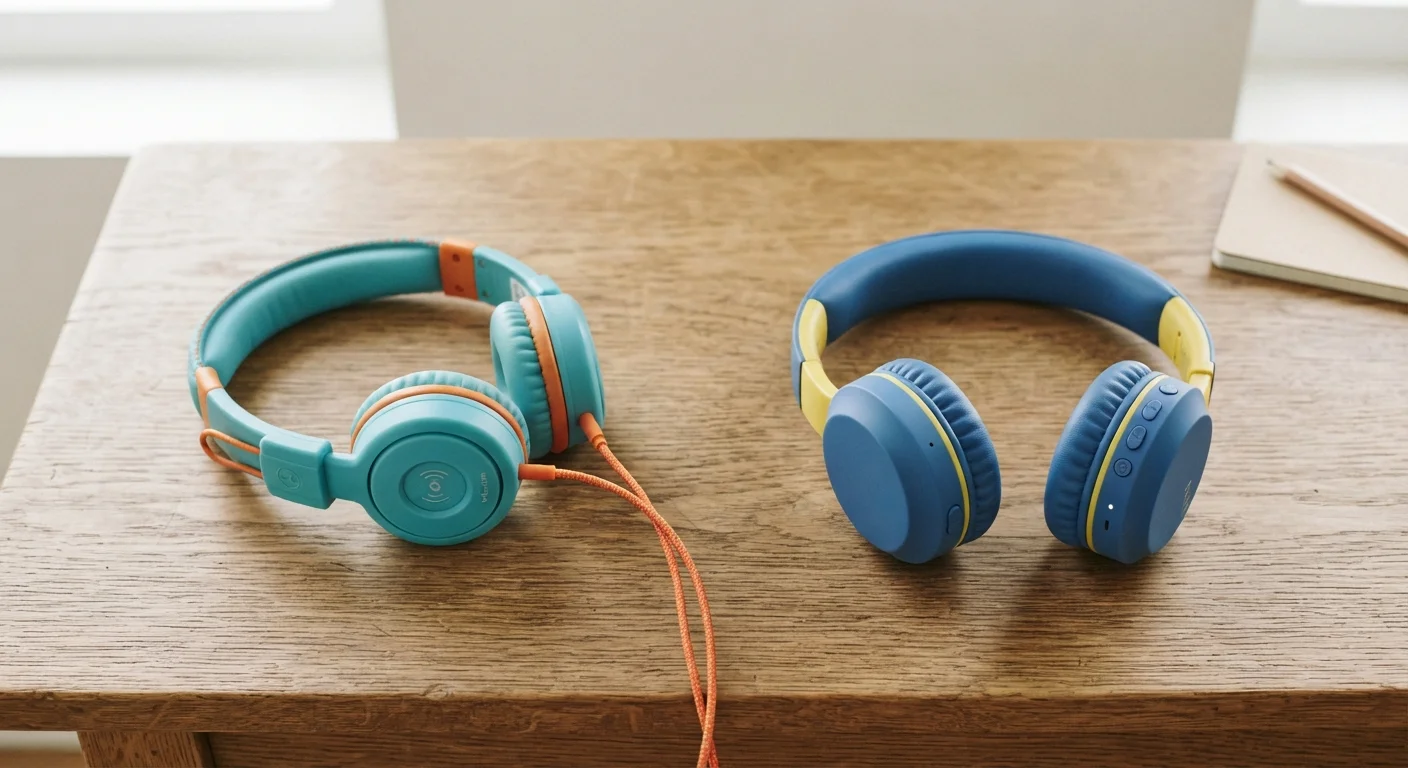
Option A
Wired headphones
The straightforward, always-ready option.
Best for: Parents who want a simple, low-maintenance solution with no batteries to charge and consistent audio delivery.
Option B
Wireless headphones
The cord-free choice built for active kids.
Best for: Families who want freedom of movement and are comfortable managing battery life and Bluetooth pairing.
How sound quality compares
At the price points most families consider for children's headphones (roughly $15 to $50), wired models have a small but measurable audio advantage. A wired connection transmits audio as a direct electrical signal, which means no compression step between the source and the driver. Bluetooth, the technology behind wireless headphones, compresses audio before transmitting it and then decompresses it on the headphone side. For adult audiophiles this matters a great deal; for a child listening to audiobooks, cartoons, or pop music, the difference is generally not perceptible.
The practical sound-quality question for kids is whether the headphone has a volume limiter, which caps output at 85 decibels (dB). The American Academy of Audiology notes that prolonged exposure above 85 dB can contribute to hearing damage over time. Both wired and wireless children's headphones can include this feature, and both can omit it. Checking the product spec sheet for a confirmed 85 dB cap matters far more than the connection type.
| Criterion | Wired headphones | Wireless headphones |
|---|---|---|
| Audio transmission | Direct electrical signal | Bluetooth with compression |
| Power required | None (device-powered) | Built-in rechargeable battery |
| Typical battery lifespan | Not applicable | 12-25 hours per charge; degrades over years |
| Cord hazard | Yes, snag risk present | No cord |
| Volume-limiting option | Available in many models | Available in many models |
| General price range (kids segment) | Lower at comparable specs | Higher at comparable specs |
| Long-term performance | Consistent over product life | Declines as battery ages |
| Ease of use for young children | Plug in and use | Requires pairing and charging |
Battery life and day-to-day convenience
Wired headphones need no power source of their own. Plug them into a tablet, laptop, or phone (via a 3.5mm jack or USB-C adapter), and they work. There is no charge level to monitor and no risk of the headphones dying mid-lesson.
Wireless headphones in the children's category typically advertise 12 to 25 hours of playback per charge, which covers most school-day and after-school use on a single charge. However, that figure assumes the battery is healthy. Lithium-ion batteries lose capacity over time, so a pair purchased for a six-year-old may deliver noticeably shorter sessions by the time the child is eight. Charging discipline also has to be taught or managed by a parent. For families already juggling device charging, adding headphones to the rotation is a minor but real friction point.
Safety considerations beyond volume limits
Cords on wired headphones present a snag risk during physical activity. A cord caught on a chair arm or pulled by a sibling can yank the headphone off abruptly, and in rare cases could pose a choking or entanglement hazard for very young children. Most cord-related incidents are simply annoying rather than dangerous, but for children under five, adult supervision during use is advisable regardless of headphone type.
Wireless headphones use Bluetooth, which emits low-level radio frequency (RF) energy. The U.S. Federal Communications Commission (FCC) sets limits on RF exposure from consumer devices, and Bluetooth operates well within those limits. Some parents remain cautious and prefer wired for this reason; that is a legitimate personal choice, but current regulatory standards classify consumer Bluetooth devices as safe for general use.
Fit also affects safety. Headphones that are too large slip and require the child to hold them in place, which defeats the purpose. Adjustable headbands and lightweight frames reduce this problem. On-ear designs that clamp too tightly can cause discomfort over long sessions, so checking clamping force and listed weight before purchase is worth the effort.
Durability and long-term value
Children's headphones take real punishment: they get dropped, sat on, stuffed into backpacks, and occasionally used as toys. Durability depends on build materials, not on whether the headphones are wired or wireless. Reinforced hinges, thick cables (for wired models), and rubberized ear cup housings all extend lifespan. A flimsy wireless pair will not outlast a well-built wired one simply because it has no cord to fray.
One durable-life advantage wired headphones hold is the absence of a battery. Rechargeable batteries in consumer electronics typically retain about 80% of their original capacity after 300 to 500 charge cycles, according to general lithium-ion battery behavior documented by battery researchers. After two to three years of regular use, a wireless pair may feel noticeably limited compared to when it was new. A wired pair with the same physical condition performs identically on day one and year three.
When a wired headphone's cable does fail (the most common wired failure point), some models accept replaceable cables, which extends the life of the ear cups and headband. Wireless headphones rarely offer user-replaceable batteries, so a degraded battery usually means replacing the whole unit.
The content provided on our blog site traverses numerous categories, offering readers valuable and practical information. Readers can use the editorial team’s research and data to gain more insights into their topics of interest. However, they are requested not to treat the articles as conclusive. The website team cannot be held responsible for differences in data or inaccuracies found across other platforms. Please also note that the site might also miss out on various schemes and offers available that the readers may find more beneficial than the ones we cover.